
How a Contractor Raised His Prices 30%, Worked 31% Less, and Took Home 40% More Profit
EXECUTIVE SUMMARY
The Reality: A 6-figure remodeling contractor raised his prices a flat 30%, took home 40.5% more profit, and worked 31% fewer jobs in the same year.
The Fix: We didn't run more ads or teach him to be a harder closer. We fixed his pricing and how he talked about his work — so he stopped getting compared to the cheapest guy in town.
The Shortcut: If you're tired of getting underbid by guys who don't do half your work and want to find out where your pricing is leaking money, book a free 20-Minute Pricing Teardown below.
From: David A. Olsen, Utah
Re: Raising your prices without losing your best customers
(Note: To honor strict NDAs and protect our clients' data, identifying details have been changed.)
He was winning 80% of his bids. Most guys in the trades would kill for that number.
But behind the scenes, he was running himself into the ground.
Good revenue. Real busy. Working 65-hour weeks, running site to site, keeping his crews fed and the lights on.
And at the end of the month? Barely anything left.
The problem wasn't his work. His work was the best around — custom remodeling, head and shoulders above the competition.
The problem was the price war.
His bids and his marketing looked exactly like everybody else's — including the guys running crews out of rusty vans. So customers did the only thing they could: compared him on price. And every single job turned into a bidding war he could only win by being cheaper.
He wasn't getting paid for his quality. He was buying his own work just to keep the schedule full.
The Fix Wasn't "Hustle Harder." It Was "Stop Being the Cheap Guy."
Every piece of advice he'd gotten said the same thing: work more, close harder, generate more leads.
I told him the opposite. He didn't need more leads. He didn't need to become a pushy salesman. He needed to stop looking, sounding, and pricing like a commodity — so customers could finally see why he was worth more.
Here's what we actually did:
We rebuilt how he talked about his work, in his bids, his proposals, and his conversations. Instead of listing features and hoping the customer figured out why he was better, we flipped it.
We showed the customer what it would cost them to hire the cheaper guy, the callbacks, the cut corners, and the headaches. He stopped selling a service and started showing people why the cheap option was the expensive mistake.
Once customers could see the difference, the price stopped being the focus of the conversation. And that's when we pulled the trigger.
The Freedom Math: How He Made More by Doing Less
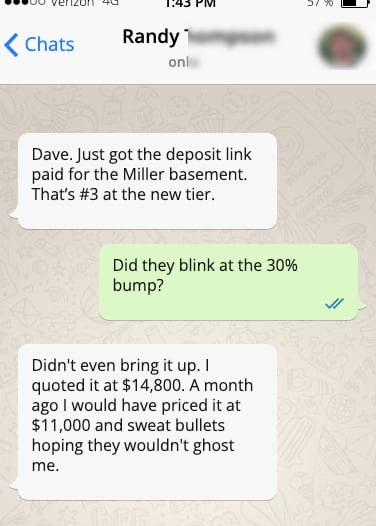
We raised his prices 30% across the board. Not on new customers only — on everything. Because he wasn't competing as the cheap guy anymore, the market took it.
Here's exactly what happened:
Before (stuck in the price war):
23 projects a year
$8,600 average job
$197,800 gross revenue
16.2% net margin
$32,000 take-home profit
After (out of the price war):
16 projects a year (7 fewer — the headache jobs disappeared)
$11,180 average job (up exactly 30%)
$178,880 gross revenue (a little less on top — on purpose)
25.1% net margin
$44,960 take-home profit
The Result
Read that again: he did fewer jobs, brought in less gross revenue, and took home $13,000 more.
The 7 jobs he didn't do? Those were the cheap customers, the nickel-and-dimers, the headaches. They disappeared — and so did all the labor, materials, and stress that came with them. His margin jumped from 16% to 25%.
More money. Less work. Better customers. That's what happens when you get out of the price war.
Is Your Pricing Leaking Money Right Now?
If any of this sounds familiar- busy but broke, getting underbid by worse guys, working harder every year and keeping less... You might be stuck in the exact same price war.
You don't need more leads. You don't need to hustle harder. You need somebody who's been there to look at your pricing and show you where the money's going.
That's what the 20-Minute Pricing Teardown is for. Free. No pitch. Just a straight look at your numbers.
Here's what we do in 20 minutes:
Your biggest leak — the #1 spot you're leaving money on every single job.
Your number — a straight estimate of how much you're losing a year to underpricing. (It's almost always more than guys think.)
Your first move — the exact change you can make this week to start fixing it, without losing your schedule.
You keep all of it whether or not we ever work together.
↓ Book Your Free Pricing Teardown ↓
WHAT OTHER OWNERS SAY...
"I was scared to raise my prices, figured everybody'd walk. David showed me exactly where I was undercharging and how to roll it out without blowing up my book. Went up 25%, lost two customers, both pains in the neck anyway. Best year I've ever had."
"I was doing $900K and couldn't figure out why I was always broke. Turns out I was basically working for free on half my jobs. David found it in one call. Fixed my pricing and I'm finally paying myself like an owner instead of an employee."
"I used to win jobs by being the cheapest. David flipped how I think about the whole thing. Now people call me because I'm good, not because I'm cheap, and I'm making more on fewer jobs. Wish I'd done this ten years ago."
"Skeptical going in... I've been burned by 'gurus' before. But he actually ran a service company, so he gets it. The first change he gave me put an extra $4K in my pocket the next month. No fluff, just stuff that works."
Quick Links
Home
About
Book a Consultation
Connect


© Olsen Strategic Advisors LLC
All Rights Reserved 2025